
The modern FX tech stack
How treasury systems must evolve to manage FX risk in today’s climate
Executive foreword
FX risk didn’t suddenly become more important in 2025. What changed was how clearly the cracks in existing treasury infrastructure were exposed.
Volatile markets, shifting interest rate cycles and geopolitical uncertainty pushed currency risk into sharper focus. Every organization felt it, but outcomes varied widely.
Some treasury teams were able to respond with speed and confidence. Others spent cycles validating numbers, reconciling spreadsheets and reacting to exposures that had already moved. The difference wasn’t experience or effort. It was whether their systems were built to support how FX risk actually behaves today.
We’ve seen these gaps surface repeatedly while working alongside corporate treasury teams through periods of volatility, rapid growth and structural change, often at the exact moment decisions needed to be made.
FX has become one of the most data‑intensive disciplines in treasury. Exposures form across planning systems, ERPs, subledgers and commercial forecasts. They change frequently. They interact with business decisions in real time. Yet most treasury technology stacks still treat FX as a reporting task rather than a dynamic risk domain.
This guide is designed to help treasury leaders step back and assess three critical questions:
- Why do traditional systems struggle as FX complexity increases?
- What kind of architecture are leading FX teams building next?
- Where does our FX program truly stand today, and what is our FX program truly capable of?
Along the way, we introduce a practical maturity framework to help you benchmark your program and understand what it takes to move from reactive execution to controlled, repeatable outcomes as we lean into 2026 and beyond.
The goal is not to prescribe a single solution. It’s to clarify what effective FX management looks like now—and what it requires from your data, workflows and technology.

Scott Bilter (CFA), AtlasFX Co-Founder
The state of FX risk management today
FX risks are increasing, and so is the complexity of managing them.
FX risks are increasing, volatility is accelerating and treasury teams are under more scrutiny than at any point in the last decade to manage these growing complexities. In 2025, this pressure intensified with 52% of practitioners expecting external risk (including FX) to increase over the next 3 years, reflecting a growing pressure on organizations to anticipate and address currency-driven earnings volatility.
In parallel, FX markets themselves are expanding and becoming more dynamic. The Bank for International Settlements (BIS) reports global FX trading volumes have surged to $9.6 trillion per day, with elevated volatility across both major and emerging currencies. This rising risk environment is colliding with operational realities that make currency management even harder.
FX remains the #1 financial exposure for global enterprises.
A majority of treasury teams continue to cite foreign exchange as their most critical risk, one that directly shapes revenue, margin, forecast accuracy and competitive positioning. When currencies move, they leave fingerprints across the entire P&L, underscoring just how foundational currency management has become to enterprise performance.
FX volatility remains one of the top external risks facing organizations today. 83% of treasurers cited FX risk as the most critical economic exposure.
- Source: PwC 2025 Global Treasury Survey
High-quality exposure data is still the largest barrier to better outcomes.
Most treasury teams struggle not because they lack hedging sophistication, but because they lack a unified, reliable view of exposures across regions, business units and systems. Forecasts often originate in planning platforms, AR/AP exposures live in ERP subledgers and commercial teams supply informal updates in spreadsheets or email.
This fragmentation introduces blind spots at every stage of the FX workflow. In practice, these blind spots often emerge mid-cycle, when forecasts shift, transactions settle differently than expected, or assumptions change after hedge decisions are already in motion.
Without consolidated, accurate data flowing into the exposure-to-hedge process, treasury teams risk hedging the wrong amounts, missing exposures entirely or operating with greater economic risk than leadership realizes.
Manual processes still dominate core FX workflows.
Even among large multinationals, manual workflows persist at scale. Exposure reconciliation, hedge decisioning, deal capture and valuation adjustments are often performed in spreadsheets that were never designed for high-frequency, high-stakes FX risk management.
These manual processes are functional, but fragile, creating inconsistent results, extending cycle times and making it difficult for treasury to operate with precision in volatile markets. Many of these workarounds exist not because teams lack sophistication, but because existing systems fail to reflect how FX exposure actually forms and evolves in real operating environments.
This is reinforced by Deloitte’s findings that “Companies continue to grapple with collating data from disparate sources to build robust cash forecasts” with 38% of organizations indicating their forecasting capabilities are below average or need development.
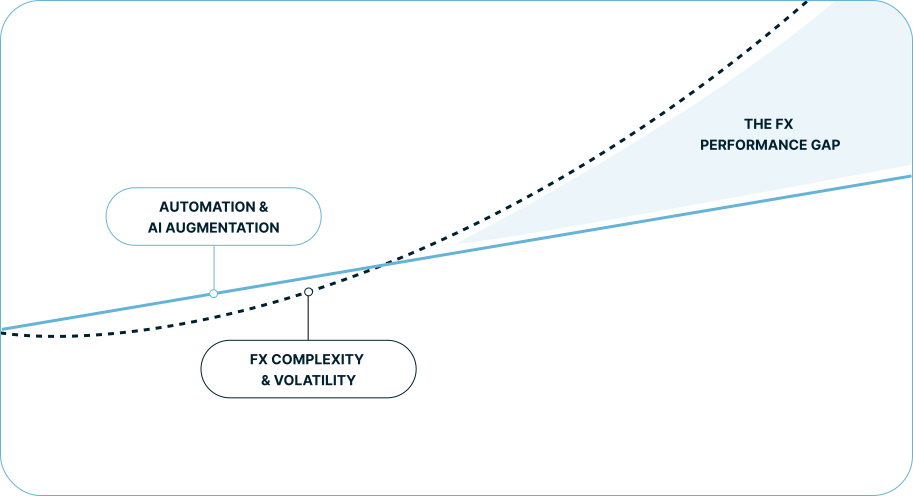
In short, the complexity of FX exposure is rising faster than the sophistication of most organizations’ supporting systems.
Treasury teams are expected to deliver tighter control, faster insights and more predictive visibility, but their foundational systems simply weren’t built for a world where exposures and market conditions shift so rapidly.
This widening gap between market volatility and system capability sets the stage for the transformation described in the rest of this guide and explains why an FX-specific infrastructure is essential heading into 2026 and beyond.
The FX data problem: why existing systems fall short
FX risk management cannot be solved without high-quality data, yet few systems were built to deliver it.
FX risk management depends on accurate, connected data, but most enterprise systems still rely on manual steps or fragmented integrations to assemble exposures.
Treasury teams know this intuitively: every cycle begins with a scramble to assemble exposures from disparate systems, validate assumptions, reconcile mismatches and chase updates across the business.
But this isn’t a workflow problem. It’s a system design problem.
Treasury teams recognize this most clearly when data gaps appear during live close cycles, hedge rollovers or forecast revisions, moments where judgment and FX context matter as much as raw data.
FX risk management is fundamentally a data discipline, and data remains the single biggest barrier to effective FX management, with 76% of PwC Treasury Survey respondents naming it as a top challenge. Most enterprise systems were never designed to handle the data structures, logic and configurability FX requires.
76% of treasury teams say poor data quality is their top barrier to effective decision-making.
- Source: PwC 2025 Global Treasury Survey
Gaps in quality, accessibility and system integration make it difficult for treasury teams to assemble a reliable picture of exposure and risk across the enterprise. When foundational exposure data is incomplete or inconsistent, every downstream action (hedge sizing, valuation, accounting, forecasting) inherits that uncertainty.
Compounding the challenge, an overwhelming number of senior finance leaders (93%) say inaccurate cash flow forecasting has led to otherwise avoidable costs in the past three years.
With this context in mind, we can see why AI and automation are beginning to play an even more meaningful role as treasury teams look for ways to clean, reconcile and analyze exposure data at scale.
74% of PwC survey respondents indicated they are either expanding or actively using AI, though only 26% of respondents felt their AI capabilities were mature.
- Source: PwC 2025 Global Treasury Survey
This widening gap between ambition and operational reality shows up across every part of treasury, but especially in FX. Teams know what they need to accomplish, but their foundational systems were never designed for the data, logic or configurability that modern FX risk management requires.
This maturity gap becomes most visible when examining the systems that treasury teams rely on today.
ERP systems were built for accounting, not FX intelligence
ERP platforms deliver excellent accounting control, but they are not designed or deployed to aggregate FX-relevant data from diverse sources, interpret the economic meaning of those exposures, or provide a unified, real-time view of exposures across entities, business units and forecast cycles. The ERP is essential, but insufficient on its own.
In real-world FX programs, this limitation becomes visible when transaction-level details, timing mismatches or forecast assumptions fall outside what standard accounting structures were built to capture.
ERP systems struggle to:
- Unify forecast and actual exposures
- Normalize currency data across entities and geographies
- Distinguish between firm commitments and forecasted flows
- Recalculate exposures dynamically based on business changes
- Structure data for advanced analysis or hedge strategy design
Treasury turns to the ERP for raw data, which is often missing the transaction currency detail required for FX risk management. Additionally, the ERP systems cannot interpret that data in a way that reflects the economic reality of FX risk.
As a result, the ERP becomes the first fracture point: essential for financial integrity, but structurally misaligned with the analytical and predictive needs of FX management.
TMS platforms were built for cash, not for FX complexity
Treasury management systems add orchestration and provide critical functionality for liquidity, bank connectivity and deal capture. But their FX modules are traditionally designed around standardized workflows that assume relatively simple, well-defined exposures and policies.
Most TMS platforms fall short in areas such as:
- Advanced exposure identification
- Dynamic hedge ratio modeling
- Complex valuation logic
- Currency-by-currency scenario analysis
- Multi-source data ingestion
- Configuration for corner cases
- Real-time integration with external systems
- End-to-end FX risk management workflow
- FX results analytics
As exposures grow more complex, treasury teams often resort to spreadsheet models and manual workarounds to build what the ERP and TMS cannot. With each manual step, these “shadow systems” introduce inconsistency, mismatches, operational risk and additional work during every cycle.
With this architecture, FX performance becomes less a question of team capability and more a question of system design.
The result: limited visibility and delayed decisions
When ERP and TMS systems are used alone, treasury faces several recurring challenges:
- Incomplete or stale exposure data
- Duplicate or misaligned data across regions
- Incorrect hedge sizes
- Inconsistent assumptions
- Difficulty comparing forecasts and actuals
- Slow reaction times during periods of volatility
- Inability to explain results
Treasury becomes locked in a cycle of catching up to exposures instead of getting ahead of them; not because the team lacks capability, but because the systems beneath them weren’t built to support the speed, precision and intelligence that modern FX management demands.
62% of treasury teams cite the lack of integration between systems as a major operational challenge.
- Source: 2021 AFP Risk Survey Report
As exposures grow more dynamic and leadership expectations rise, the gap between what treasury needs and what legacy tools can deliver has become ever wider and impossible to ignore.
This is the moment when organizations begin to ask the right questions:
- How mature is our FX program?
- What would it take to operate with precision instead of improvisation?
Benchmark your FX program
Every FX hedging program is the product of dozens of decisions, some intentional and some inherited. We’ve outlined the pressures and gaps facing FX risk management. Over time, those decisions shape the systems, processes, workflows and assumptions that govern how your organization manages currency risk.
While volatility, growth and shifting business models can all expose weaknesses, the core question remains the same:
Where are you today and what is your FX program truly capable of?
A maturity assessment helps treasury teams answer that question with clarity. It removes guesswork, replaces anecdote with structure and creates a shared language for evaluating how exposure data, technology, governance and workflows support (or hinder) FX performance. It also highlights the biggest accelerators of progress—and the biggest sources of friction.
While every organization is different, most FX programs settle into one of four common maturity stages. These stages drive big differences in exposure accuracy, hedge outcomes and operational efficiency.
Most importantly, maturity defines how predictable your FX outcomes can be. In our experience, the true test of maturity isn’t how a program looks on paper, but how consistently it performs when volatility spikes or assumptions change unexpectedly.
Programs with high maturity are proactive, data-driven and aligned with leadership expectations. Programs with low maturity are reactive, heavily manual and constrained by systems that weren’t built for FX complexity.
Use this chapter to assess where your team fits and how your approach compares to the strongest programs in the market.
Level 1: Reactive
Organizations at the Reactive level are aware of their FX exposures but lack a consistent, system-driven way to measure, monitor or manage them.
Data is fragmented, workflows are manual and each cycle depends heavily on manual work and memory. Treasury can respond to volatility, but only after exposures have already shifted making FX a lagging rather than leading indicator.
Indicators include:
- Exposure data collected manually across business units
- Hedging decisions made ad-hoc or based on directional views
- Inconsistent reporting and limited visibility
- Significant reliance on spreadsheets
- Limited analytics or scenario planning
- Frequent earnings surprises tied to FX
This level feels like:
A month-end scramble to reconcile numbers, exposures that change without warning and constant pressure to validate data before decisions can be made.
Level 2: Standardized
Companies at the Standardized level have implemented consistent processes but still lack full integration or automation.
Treasury has defined workflows, recurring templates and partial system reliance but core exposure data still requires manual workarounds and assembly. Visibility improves, yet exposures remain inconsistent and forecast–actual mismatches persist.
Treasury can manage FX cycles reliably but not efficiently.
Typical characteristics:
- Exposure data partially automated from ERP or TMS
- Documented hedge policy
- Periodic reporting (monthly or quarterly)
- Manual hedge accounting or partial automation
- Occasional use of sensitivity analysis
- Ongoing workarounds in spreadsheets
This level often feels like:
More control than Level 1, but still buried in a mire of spreadsheets. Teams here have better visibility, but lack confidence. Repeatable workflows exist, but are not yet optimized.
Level 3: Integrated
At the Integrated stage, treasury has moved beyond standardization into a more connected, data-driven operating model with reduced manual reconciliation and a clearer exposure-to-hedge workflow.
Treasury gains speed and consistency, with improved data quality and stronger alignment between forecasts, exposures and hedge actions. While complexity still creates friction, the program begins to operate with discipline rather than improvisation.
Teams at this stage are also better equipped to explain outcomes to leadership, not just report results—an often overlooked but critical marker of FX maturity.
Indicators include:
- Automated exposure aggregation from multiple systems
- Consistent methodologies across geographies
- Stronger alignment to cash flow and earnings risk
- Integrated hedge accounting
- Forward-looking analytics and scenario modeling
- Shared dashboards for visibility
- Early adoption of enterprise currency management (ECM) or advanced tools
This level feels like:
You’re finally getting ahead of the cycle instead of chasing it, with more predictable data, tighter coordination and fewer last-minute adjustments.
Level 4: Enterprise currency management (ECM) leadership
At this stage, configurability becomes essential. Organizations need a platform that models their exact entity structures, exposure logic and workflows rather than forcing them into template-based processes.
Only a small percentage of organizations operate at this level, but the trend is accelerating. FX becomes a fully systematized, analytical discipline and they operate with purpose-built FX infrastructure that unifies exposure data, automates core workflows and enforces consistent connectivity across the business.
Treasury can model scenarios, respond dynamically to volatility and provide strategic insight to leadership. All sources of variance are well understood, and can be quickly addressed. FX becomes a controlled, predictable, scalable process rather than a monthly fire drill.
Capabilities include:
- Near-real-time exposure capture and monitoring
- Automated netting of exposures and hedge suggestions
- Multi-horizon scenario and stress testing
- Integrated valuation and hedge accounting
- Consistent global governance with local flexibility
- Deep visibility into bank execution quality
- FX insights embedded into commercial decision-making
This level often feels like:
Organizations at this level often use a purpose-built ECM platform to connect ERP, TMS, trading and reporting systems into one consistent FX workflow, providing them the confidence, clarity and control the ability to see risk early, act quickly and deliver measurable, repeatable outcomes that leadership trusts.
This maturity model reveals a clear pattern: most companies sit between Levels 1 and 2, while market-leading companies have accelerated toward Levels 3 and 4. Wherever your organization lands, reaching the next level requires an infrastructure that treats FX not as a function but as a data discipline and a strategic risk domain in its own right.
This is where enterprise currency management (ECM) enters the story.
The rise of enterprise currency management (ECM)
ECM emerged because FX risk management cannot be treated as a subset of cash or accounting.
Enterprise currency management (ECM) is emerging as the system of record that brings together exposure data, analytics and execution workflows. ECM platforms increasingly incorporate automation, machine learning-driven reconciliation and AI-supported insights to strengthen accuracy and consistency across the FX lifecycle and create a single, consistent operating model for managing currency risk across the organization.
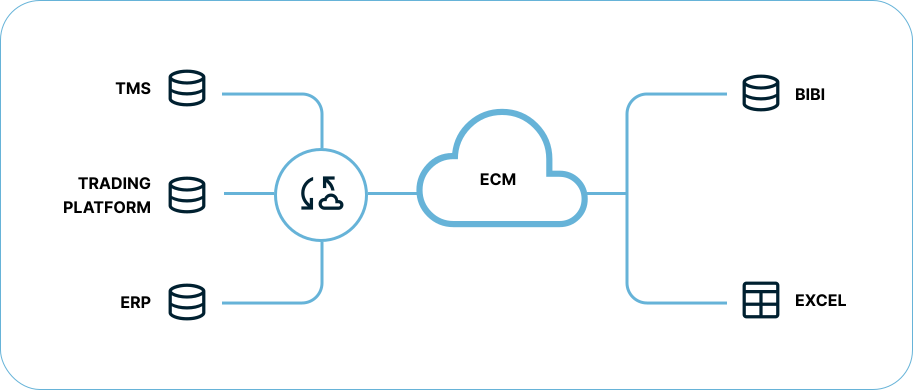
As automation and AI adoption increase across finance, treasury teams recognize that FX workflows need their own dedicated infrastructure, one that treats currency risk as a dynamic, data-driven discipline rather than a monthly reporting exercise.
What is enterprise currency management?
ECM serves as the FX intelligence layer in the modern finance tech stack, sitting between:
- ERP: for source exposure data and accounting
- TMS: for deal capture, settlement and liquidity
- FX Trading Platforms: for rates, execution and confirmations
- Reporting systems: for business intelligence and consolidation
At its core, the ECM layer brings structure and intelligence to every step of the FX process. It pulls in exposures from each source system, cleans and standardizes the data and helps shape the right hedge strategy.
It also models potential outcomes, connects execution workflows, handles valuation and hedge accounting and provides the analytics and governance tools needed to oversee the entire program with confidence.
ECM doesn’t replace ERP or TMS. It complements and interprets them, elevating both into a cohesive FX ecosystem that matches the complexity of modern global business.
Treasury teams rate their TMS only 3.4 out of 5 for short-term forecasting and 3.5 out of 5 for bank fee analysis—clear signals that key gaps remain.
- Source: PwC 2025 Global Treasury Survey
Why ECM became essential in 2025
As organizations scale, expand globally, diversify their revenue or shift their operating models, FX complexity increases exponentially. Treasury teams can’t manage currency risk accurately or consistently when exposure data is incomplete, workflows are fragmented and critical logic sits outside core systems.
This complexity exposes every weakness in the environment described in earlier chapters and leads to a simple conclusion: FX risk management needs its own infrastructure now more than ever.
This conclusion didn’t emerge from theory. It came from repeated exposure patterns, edge cases and operating realities that couldn’t be handled cleanly within traditional ERP or TMS structures. That’s why 2025 became the tipping point. Four forces combined to make ECM not just useful, but essential.
1. Market volatility exposed weaknesses in legacy processes.
Recent periods of heightened volatility made visible what had previously been manageable. When currency swings became more frequent and more significant, manual and semi-manual workflows were too slow. Treasury teams found themselves spending more time validating numbers than managing risk, revealing how fragile and effort-dependent their FX workflows had become.
2. Treasury’s role within the enterprise expanded.
Treasury’s role within the enterprise expanded significantly, with expectations rising for the function to inform pricing strategy, margin impacts, competitive dynamics, cross-border planning and earnings sensitivity. Expectations rose not just for accuracy but for insight, with treasury teams expected to forecast, explain and influence the business impact of currency movement.
Meeting these demands required deeper analytics, more reliable data and tighter integration with systems across finance and the broader business that legacy workflows and systems couldn’t consistently deliver.
3. Corner-case complexity became too expensive to handle manually.
Every organization has its own exposure patterns, hedge policies, intercompany flows, accounting treatments and market dynamics. The “80% solution” offered by ERP and TMS platforms could handle the baseline, but couldn’t support the nuanced modeling required for modern FX decisions.
ECM platforms are built for configurability, not standardization, making them uniquely suited for FX. That configurability reflects the reality that no two FX programs behave the same once timing differences, intercompany workflows and market dynamics are taken into account. The workarounds required to compensate (spreadsheets, manual overrides, one-off models) became costly, inconsistent and increasingly unsustainable as complexity grew.
4. Modern connectivity enabled new levels of integration.
Modern ECM platforms are designed to integrate with ERP, TMS, data providers, planning systems, trading platforms and reporting tools using a range of secure connection methods, without the heavy customization historically required.
This made it possible to connect exposure, strategy, execution and accounting into a single, cohesive workflow—something that previously required extensive custom development or manual effort. For the first time, treasury teams could build a seamless FX lifecycle and operate with faster, more consistent insight across systems.
Where does AtlasFX fit in the modern FX tech stack?
AtlasFX represents the type of ECM solution that gained traction in 2025. It is built for configurability, deep exposure analytics and partnership-driven deployment. While not the only ECM platform in the market, it is by far the most comprehensive, and exemplifies the specialized approach the industry is moving toward.
Treasury leaders increasingly view ECM architecture as the logical evolution of their finance tech stack.
Best-of-breed architecture vs. the “all-in-one” trap
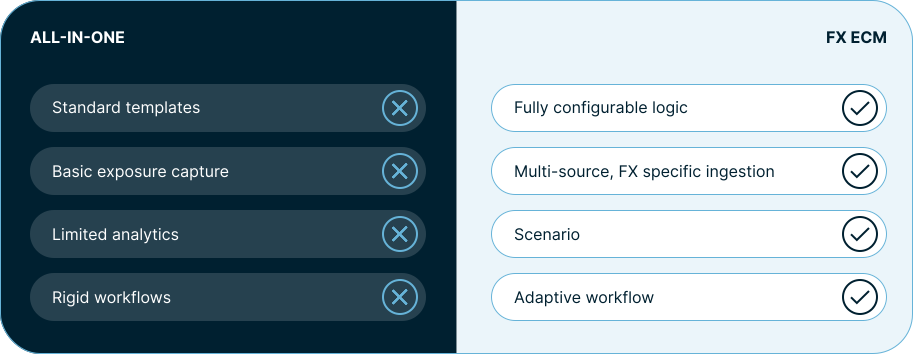
Large enterprises attempted the all-in-one approach—but FX made the limitations clear.
For the last decade, many organizations have attempted to consolidate treasury and FX processes into a single vendor ecosystem. But FX complexity proved difficult to standardize and costly to force into rigid workflows. Many organizations arrive at this realization after attempting consolidation and encountering its limits during live FX cycles, not during system selection.
Most monolithic systems struggled under the weight of modern FX requirements. Their limited configurability made it nearly impossible to accommodate unique business structures, and the absence of advanced analytics pushed treasury teams toward spreadsheets to fill critical gaps.
Additionally, slow upgrade cycles and complex implementations created ongoing disruption, and many vendors lacked the FX-specific expertise needed to support nuanced exposure management or valuation workflows.
The real cost of all-in-one systems
All-in-one platforms often appear simpler on the surface, but the simplicity is misleading. When ERP or TMS platforms stretch beyond their intended scope, treasury teams experience:
- Excessive manual effort
- Inconsistent data and assumptions
- Limited visibility into true exposures
- Slower reactions to market moves
- Gaps in hedge accounting
- Increased “offline” workflow
- Recurring reconciliation challenges
- Higher operational risk
When volatility is low, these limitations are frustrating. When volatility is high, they are costly. As exposures become more dynamic and the business becomes more global, the inflexibility of an all-in-one approach slows decision-making, reduces visibility and creates operational drag at the exact moments treasury teams need clarity.
Why best-of-breed is becoming the standard
Best-of-breed architecture is gaining adoption for several reasons:
- Each component is optimized for its function
- Integrations are streamlined through modern connectivity
- Organizations gain the flexibility to scale or evolve the stack
- Treasury can adopt specialized FX capabilities without disrupting core systems
- Upgrades and innovations happen faster
In this architecture, ERP and TMS remain essential foundations, while ECM fills the FX-specific gap. The result is not more systems, but better alignment across the systems that already exist, giving treasury the flexibility to evolve as the business evolves.
With 65% of organizations planning to expand API use, treasury is moving beyond standalone TMS platforms toward modular, connected ecosystems.
- Source: PwC 2025 Global Treasury Survey
How AtlasFX supports a best-of-breed architecture
A best-of-breed architecture depends on each system excelling at what it was designed to do and being able to integrate cleanly with the rest of the FX ecosystem. As a purpose-built ECM platform, AtlasFX demonstrates these advantages with:
- Deep configurability for corner cases
- Unsurpassed data “deep dive” and cleansing capability
- Advanced exposure analytics
- Integrated valuation and hedge accounting
- Multi-asset class support for FX options and interest rate swaps
- Bank relationship intelligence
- Deployment handled directly by the product experts
- Extremely low churn as a result of ongoing partnership
Taken together, these capabilities reflect lessons learned supporting complex, global FX environments, where edge cases, timing mismatches and market shifts make modular, purpose-built tools more effective than monolithic platforms.
How treasury teams are modernizing FX
The trends outlined in this report make one thing clear: FX programs that stay reactive will struggle to keep up with the pace of change.
The pressures introduced in 2025—persistent volatility, expanding treasury mandates and growing operational complexity—now define the baseline. Treasury functions are no longer supported by isolated tools. Technology has become the foundation for agility, control and insight, with real-time access to cash, exposure and forecast data increasingly viewed as essential.
Most organizations have responded by investing in core treasury systems. Ninety-four percent of treasury teams now operate a dedicated TMS, reflecting how central technology has become to managing scale and complexity. Yet adoption of full functionality remains uneven. Many teams still rely on offline or homegrown tools for short-term forecasting, reporting and financial risk management, and satisfaction with these capabilities remains moderate at best.
This creates a familiar tension. The technology foundation is in place, but critical gaps persist where FX data, analytics and workflows extend beyond what core systems were designed to handle. As market conditions grow more dynamic and leadership expectations rise, those gaps become harder to manage with manual workarounds or disconnected processes.
Treasury teams preparing for 2026 are focusing on strengthening exposure data, streamlining FX workflows, expanding analytics and ensuring their technology ecosystem can adapt as risk, scale and complexity evolve.
These shifts are no longer aspirational. They are becoming the minimum standard for operating with confidence in modern FX markets.
80% of companies use AI to improve efficiency, but the highest performers also use it to unlock growth and innovation.
- Source: McKinsey, The state of AI in 2025
The priorities below reflect where leading teams are already investing.
1. Strengthen exposure data quality
Enhancing exposure data is the single most impactful step a treasury team can take. Accurate exposure data leads to better hedge sizing, more reliable forecasts, fewer surprises and is the clearest differentiator between reactive and mature FX programs.
Key actions:
- Automate accurate exposure capture from ERP, planning and subledger systems
- Cleanse the data where required, to avoid suffering from “garbage in, garbage out”
- Establish consistent data definitions
- Create regular refresh cycles (monthly, weekly or daily)
- Implement data validation checkpoints
- Eliminate redundant or conflicting data sources
Teams that get exposure data right see immediate improvements in hedge performance and visibility.
2. Consolidate and streamline FX workflows
Fragmented processes create delays and inconsistencies that become harder to manage as exposures grow more dynamic. Treasury teams preparing for 2026 are consolidating FX operations into a consistent, automated workflow that spans exposure capture, strategy, execution and accounting.
This includes:
- Standardizing exposure capture
- Integrating valuation and accounting
- Eliminating redundant spreadsheets
- Creating shared dashboards across treasury, finance and FP&A
The goal is not centralization for its own sake, but cohesion; the ability to operate with speed and clarity under any market condition.
3. Improve hedge strategy design and analytics
Leading teams in 2025 leaned heavily on scenario analysis, sensitivity modeling and multi-horizon forecasting to improve hedge decisions. As the pace of business increases and exposures change more frequently, analytics are no longer an enhancement—they are an expectation.
Recommended actions:
- Run stress tests and forward-looking simulations
- Understand portfolio and marginal risk for all material exposures
- Understand all the sources of variance in your hedging programs
- Quantify the cost of hedging vs. risk reduction
- Explain all the FX-related deltas to the annual plan on demand
- Embed FX scenarios into business planning cycles
These capabilities become essential as markets move quickly and exposures change more frequently.
4. Strengthen bank relationship management
In an increasingly competitive banking environment, treasury teams need visibility into how banks price, execute and respond to FX trades. Market conditions in 2025 underscored how performance varies across banks and how data-driven insights help treasury optimize counterparties and execution quality.
Core capabilities include:
- Tracking fill quality
- Analyzing bank win rates
- Evaluating spread competitiveness
- Identifying trends in execution performance
- Optimizing counterparty allocations
As FX programs mature, many treasury teams are adopting dedicated tools to support this discipline. BankMinder, a module within the AtlasFX platform, was designed specifically to help treasury teams analyze pricing quality, execution outcomes and counterparty risk within a single, objective framework.
Rather than focusing on individual trades or reactive reviews, this approach enables treasurers to benchmark performance, align wallet share with value delivered and strengthen bank relationships through transparency and consistency—outcomes that became increasingly important as market conditions tightened.
5. Move toward an ECM-centered architecture
The next evolution of the finance tech stack is clear: ECM sits between ERP, TMS and banks, creating the centralized intelligence layer FX programs have been missing.
As more organizations shift to this model, the advantages in data quality, workflow consistency and overall visibility are becoming hard to ignore. For teams reevaluating their architecture in 2026, ECM represents not a technology purchase, but an operating model upgrade.
Treasury teams preparing for 2026 should:
- Assess gaps in exposure management, workflow and analytics
- Evaluate ECM solutions for fit and configurability
- Design data flows between systems
- Define governance, controls and ownership
- Plan phased implementation that reduces operational friction
This approach future-proofs the FX function without disrupting core systems, preserving what works while strengthening what matters most.
“So, what does “good” look like? Seamless ERP-TMS-bank integration, scalable digital tools, cross-functional ownership and a focus on business outcomes—not just system implementation—will continue to be hallmarks of positioning organizations to operate at peak effectiveness.
To do so, treasury teams must act as both architects and stewards of a digital ecosystem that drives resilience, insight and enterprise value.”
- Source: PwC 2025 Global Treasury Survey
Building the next phase of your FX strategy in 2026 and beyond
Treasury’s role expanded significantly in 2025. Expectations rose, volatility increased and complexity accelerated. In this environment, the organizations that performed best were those that recognized FX cannot be managed effectively with generic systems or manual workarounds.
The most meaningful gains came not from adding more tools, but from aligning data, workflows and analytics with how FX decisions are actually made under pressure.
These teams invested in exposure data extraction, integrated workflows, consistent methodology and dedicated currency management technology, building FX programs that were accurate, repeatable and responsive to market shifts.
Looking ahead to 2026, the case for enterprise currency management is clear.
Preparing your FX program for 2026 is about more than readiness for next year’s volatility. It’s about building a foundation that can adapt to new markets, new business models, new data requirements and new expectations from leadership.
The strongest FX programs will be those that unify their workflows, strengthen their exposure data, prioritize automation and put the right intelligence layer at the center of their architecture.
As global business models evolve and market dynamics remain unpredictable, treasury teams need the infrastructure, analytics and workflows to support strategic currency decisions at scale.
The modern FX program isn’t defined by the tools it uses, but by how well those tools work together. Treasury teams that build an integrated, best-of-breed architecture today will be better positioned to manage risk, support the business and navigate whatever comes next.
Continue the conversation
If this guide raised questions about your FX program—or helped clarify where limitations may exist—we’d welcome the opportunity to talk it through. We approach these conversations as practitioners first, grounded in firsthand experience managing FX challenges inside corporate treasury teams.
- Learn more about AtlasFX
Explore our website to learn more about our approach to enterprise currency management and how leading teams are modernizing FX workflows.
- Talk with us
Reach out with questions, ideas or to discuss how your current FX architecture supports—or constrains—your goals.
The strongest FX programs don’t start with a system change. They start with clarity, dialogue and informed decisions. We’re here to support that process.
Table of Contents
- The modern FX tech stack
- The state of FX risk management today
- The FX data problem: why existing systems fall short
- Benchmark your FX program
- The rise of enterprise currency management (ECM)
- Best-of-breed architecture vs. the “all-in-one” trap
- How treasury teams are modernizing FX
- Building the next phase of your FX strategy in 2026 and beyond
Download the guide and keep reading
Get expert insights and practical guidance to help your team build a more connected, modern FX workflow. Please complete the form to access your copy and continue reading.


